
Anthropic now has two “top-tier” models on the market at the same time: Claude Opus 5, released July 24, 2026, and Claude Fable 5, its Mythos-class flagship that’s been generally available since July 1. Both show up in the same model picker. Both can handle serious coding and reasoning work. And their prices are exactly 2× apart. So which one should you actually be pointing your workload at?
Quick verdict: If your work is agentic automation, computer-use tasks, or general day-to-day coding and reasoning, Opus 5 gets you most of Fable 5’s capability at half the price. If you’re doing frontier-level software engineering, cybersecurity research, or specialized legal/medical reasoning where the last few points of accuracy matter, Fable 5 still leads, and for now, that lead costs real money, since it’s billed through separate usage credits rather than your subscription.
The Access Difference Matters More Than It Looks
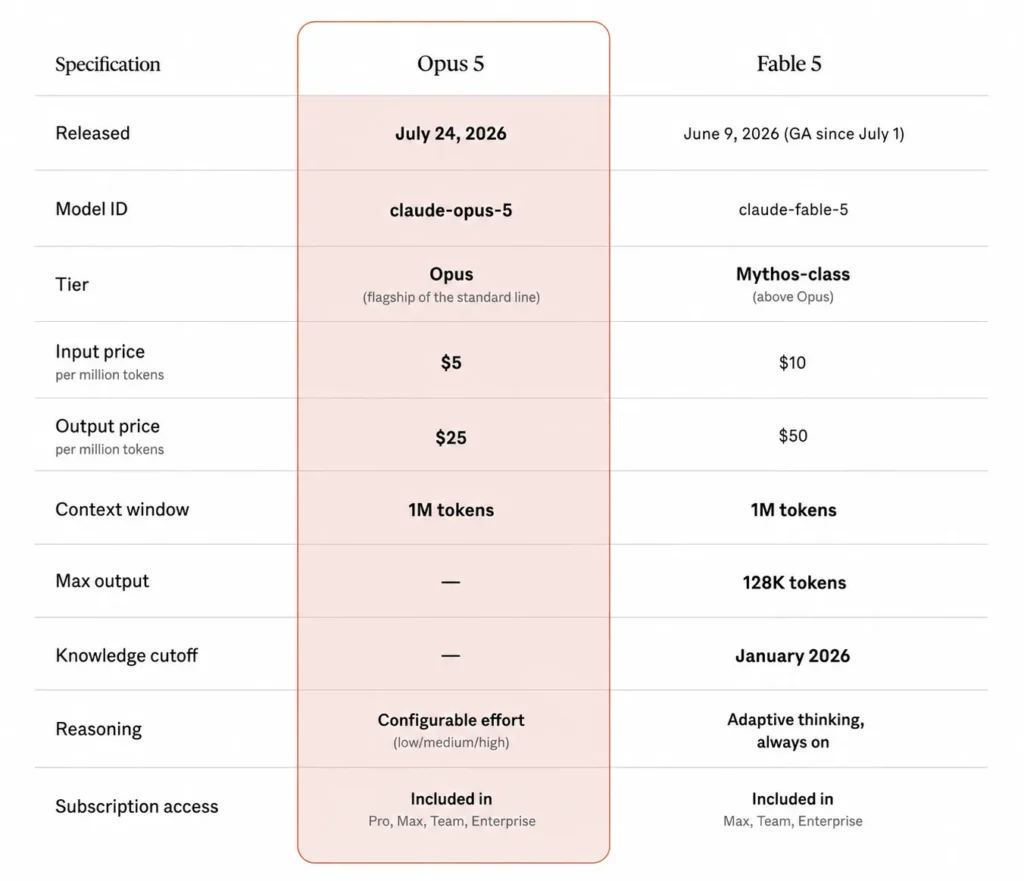
This is the part easy to miss if you’re only comparing spec sheets. Opus 5 is bundled into a standard Claude subscription, if you’re on Pro, Max, Team, or Enterprise, you already have it. Fable 5 is included only in the Max, Team, and Enterprise plans; using it on the Pro plan now means purchasing usage credits separately, in addition to the plan you already pay for.
That changes the real-world comparison from “which model is better” to “is Fable 5’s edge worth paying twice, on top of a subscription that already includes a very capable model for free.” For a lot of workloads, the answer is no, which is exactly the gap Anthropic built Opus 5 to fill.
Worth knowing for context: Fable 5 also isn’t a model with a completely uneventful history. It launched June 9, was suspended on June 12 to comply with U.S. Department of Commerce export controls, and wasn’t restored until July 1 after those controls were lifted. It’s been generally available and stable since then, but it’s had less runway in the wild than Opus 5’s steady, incremental predecessor line.
Pricing, With Real Numbers
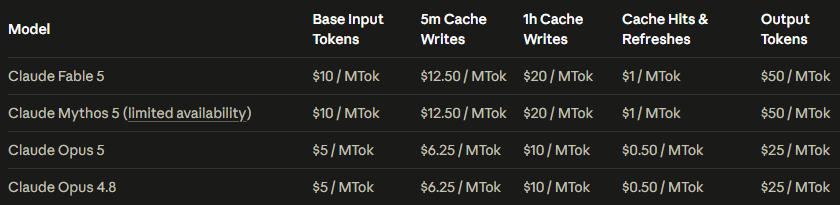
A useful way to think about the price gap: a task that takes Fable 5 4,000 output tokens to solve correctly costs the same as a task that takes Opus 5 8,000 output tokens to solve correctly. If Opus 5 needs meaningfully more back-and-forth to reach the same quality answer, the price advantage shrinks fast. Anthropic’s own benchmark disclosures (below) suggest that gap is real but narrower than 2× in most categories, which is the whole argument for Opus 5 existing.
Head-to-Head Benchmarks
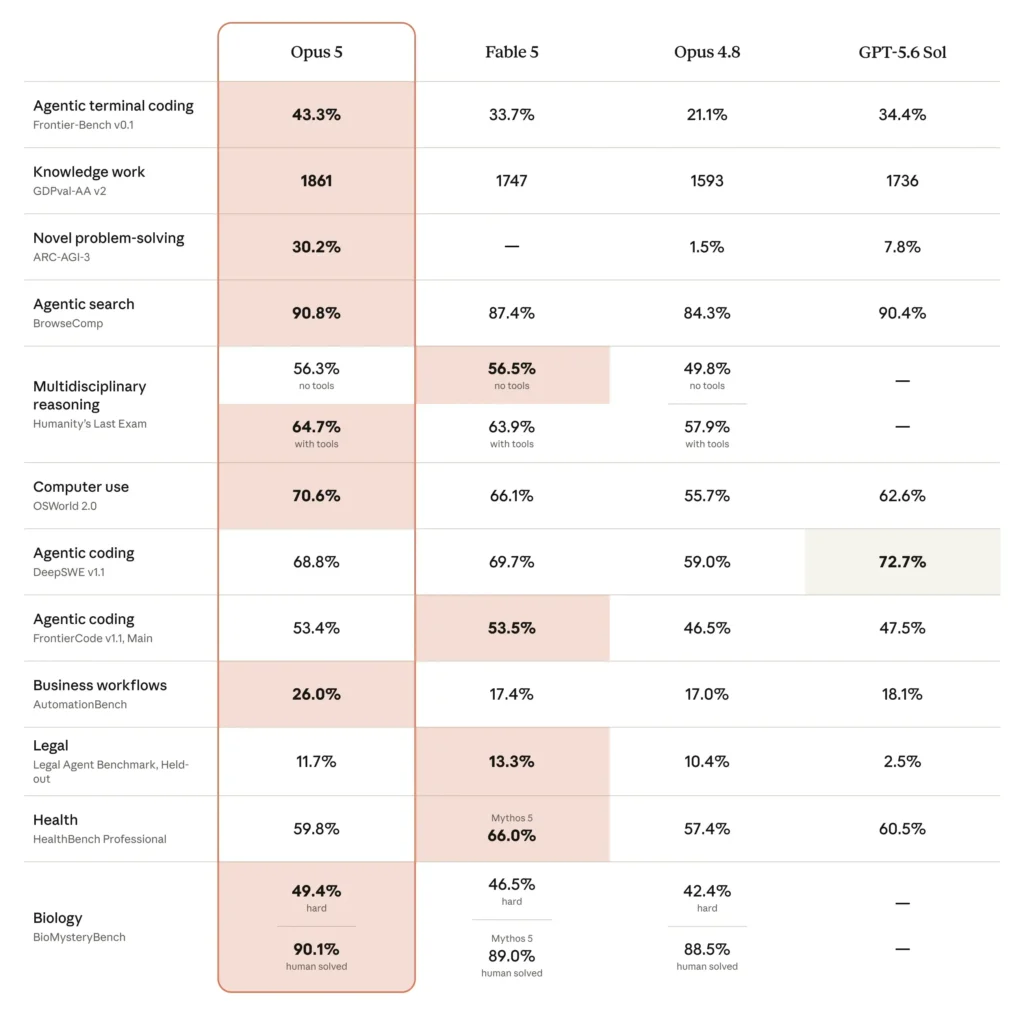
Anthropic published a direct comparison table with Opus 5’s launch, and it’s unusually candid, Fable 5 wins several categories outright.
| Benchmark | Opus 5 | Fable 5 |
|---|---|---|
| Humanity’s Last Exam (no tools) | 56.3 | 56.5 |
| Legal Agent Benchmark | 11.7 | 13.3 |
| HealthBench Professional | 59.8 | 66.0 |
| Frontier-Bench v0.1 | 43.3 | 33.7 |
| OSWorld 2.0 | 70.6 | 66.1 |
The pattern is consistent with how Anthropic positioned each model. Fable 5 keeps its lead in the categories it was specifically built to dominate, deep expert reasoning, specialized professional domains like law and medicine. Opus 5 pulls ahead on more open-ended, agentic tasks: operating software autonomously and working through unstructured terminal-based problems.
Categories where only Fable 5 has a published score (no direct Opus 5 comparison exists yet): Fable 5 posted 80.3% on SWE-Bench Pro and 78.0% on ExploitBench at launch, both categories where it built a substantial lead over Opus 4.8 (69.2% and 40.0% respectively). Anthropic’s own Opus 5 materials acknowledge the model “trails Mythos 5 on cybersecurity and biology,” and specifically that on OSS-Fuzz, Opus 5 finds vulnerabilities about as well as Mythos 5 but is “far behind” on turning those findings into working exploits. If your work touches security research, that gap is worth taking seriously rather than assuming Opus 5 closes it the way it does elsewhere.
Safety and Alignment
Anthropic’s Opus 5 system card places both models in the same overall risk category, “very low” alignment risk, and states that Opus 5’s AI R&D capabilities are comparable to Claude Mythos 5’s, though neither is close to substituting for Anthropic’s own research staff. On chemical and biological risk, Opus 5 is classified as having CB-1 capabilities (relating to synthesis of non-novel weapons) but not CB-2 (novel weapons synthesis) the same threshold most current frontier models sit at. This isn’t a meaningful safety differentiator between the two models for typical development or business use; it mainly confirms neither model represents a step change in dual-use risk over its predecessors.
Use both: A pattern that’s emerging among teams with both available is routing by task. Opus 5 for the high-volume, everyday work, with an explicit escalation path to Fable 5 credits for the specific tasks where the accuracy gap is worth paying for. That’s arguably the setup Anthropic designed this pricing structure to encourage.
FAQ
Yes, it’s included in Pro, Max, Team, and Enterprise plans at no extra cost, replacing Opus 4.8 as the default flagship.
Opus 5, by exactly half: $5/$25 per million tokens versus Fable 5’s $10/$50.
The Bottom Line
Claude Opus 5 isn’t trying to dethrone Fable 5, Anthropic’s own numbers say it doesn’t, in several categories that matter. What it does is make the “good enough” tier dramatically more capable while keeping it inside your existing subscription, pushing Fable 5 into the role of a specialized, pay-as-you-go tool for the specific tasks that still need frontier-ceiling performance.
Pricing, benchmark figures, and specs in this article reflect Anthropic’s published documentation and system cards as of July 24, 2026, and are subject to change.