

Anthropic released Claude Opus 5 on July 24, 2026, its first Opus refresh since Opus 4.8 shipped back in May. The pitch is straightforward: a model that comes close to the frontier intelligence of Claude Fable 5, Anthropic’s most capable model, at roughly half the cost. For anyone deciding which Claude model to build on this week, here’s what actually changed, what it costs, and where the benchmarks back up the marketing.
What Is Claude Opus 5?
Opus 5 is positioned as the model you reach for every day, not just for the hardest problems. Anthropic describes it as a thoughtful, proactive model built for consistent, efficient performance across ordinary business and coding tasks, the kind of work that doesn’t need Fable 5’s absolute ceiling but still benefits from Opus-class reasoning.
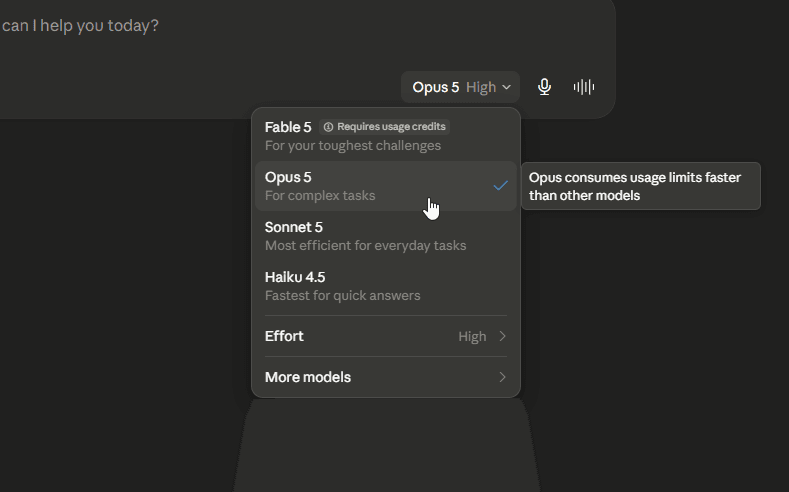
The headline new feature is effort control: a low/medium/high toggle that lets you trade capability for cost and speed on a per-task basis. Instead of picking a model tier and living with its fixed cost profile, you can dial Opus 5 down for routine work and up for harder problems within the same model. Anthropic says this also cuts down on the back-and-forth typically needed to get a usable answer, which matters more than it sounds, a task that finishes in four attempts at higher cost per attempt can still be cheaper overall than one that needs twenty cheaper attempts to get right.
Opus 5 becomes the new default Opus-tier model in the Claude apps, effectively replacing Opus 4.8 in the model picker for Pro, Max, Team, and Enterprise plans. It’s also now the most capable model included in a standard Claude Pro subscription, Fable 5 sits above it, but subscription-inclusive access to Fable 5 ended on July 19, 2026, meaning general users now reach it through separately purchased usage credits rather than their plan quota.
Pricing: Same as Opus 4.8, Half of Fable 5
This is the detail that’s easy to get wrong from the headlines. Opus 5’s per-token pricing is identical to Opus 4.8’s, not half of it:
| Input | Output | |
|---|---|---|
| Standard | $5 / million tokens | $25 / million tokens |
| Batch API | $2.50 / million tokens | $12.50 / million tokens |
| Prompt cache hits | $0.50 / million tokens | – |
| Fast mode (API only, research preview) | $10 / million tokens | $50 / million tokens |
The “half the price” claim compares Opus 5 to Fable 5, which is priced at $10 / $50 per million tokens, exactly double Opus 5’s standard rate. So the comparison that matters is: does Opus 5 get close enough to Fable 5’s output quality to justify the price gap? The benchmarks below are Anthropic’s attempt to answer that.
Fast mode, which runs roughly 2.5× faster than the default, is currently a Claude API-only research preview at double the standard price. On Claude Code, fast mode access requires separately purchased credits rather than being bundled into a subscription.
Opus 5 is available immediately as claude-opus-5 across the Claude API, Claude.ai, the Claude apps, Claude Code, Cowork, Amazon Bedrock, Google Cloud Vertex AI, and Microsoft Foundry.
Benchmark Performance: Where Opus 5 Wins, and Where It Doesn’t
Anthropic published a benchmark table comparing Opus 5 against Fable 5 and OpenAI’s GPT-5.6 Sol, and notably, didn’t hide the categories where Opus 5 loses. That transparency is worth taking at face value, since it lines up with independently compiled benchmark trackers.
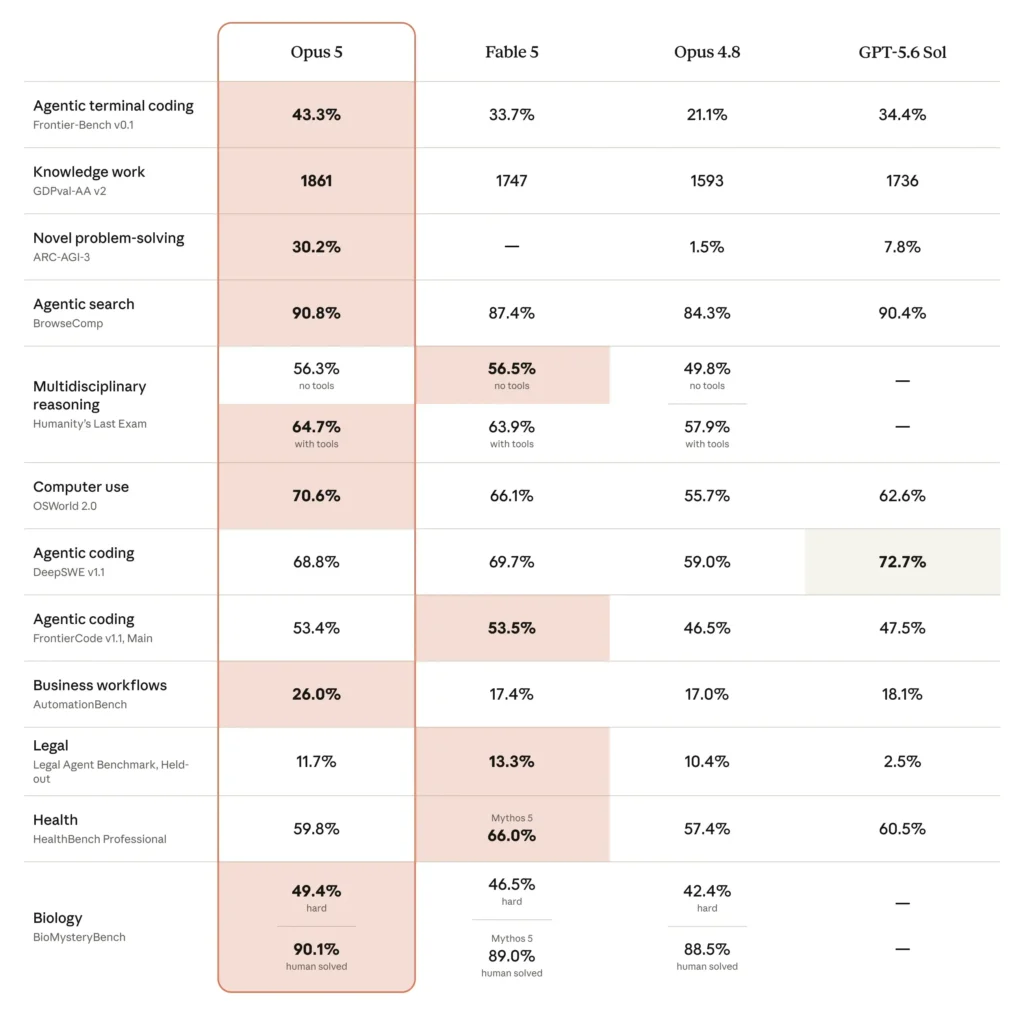
Where Opus 5 leads clearly:
- Frontier-Bench v0.1 (terminal-based coding work): Opus 5 scored 43.3%, ahead of both Fable 5 (33.7%) and GPT-5.6 Sol (34.4%)
- OSWorld 2.0 (operating a computer via clicking and typing): Opus 5 scored 70.6% against Fable 5’s 66.1%
- AutomationBench (completing an ordinary business task start to finish): Opus 5 scored 26.0% against GPT-5.6 Sol’s 18.1%
- BrowseComp (finding hard-to-locate information on the open web): Opus 5 scored 90.8%
- Life sciences evaluations broadly: Anthropic reports gains over Opus 4.8 on every science benchmark it ran, including a 10.2 percentage-point jump on inferring molecular structure from spectroscopy data and a 7.7-point gain on predicting how protein sequence changes affect function
Where GPT-5.6 Sol or Fable 5 still lead:
- DeepSWE v1.1 (agentic coding): GPT-5.6 Sol scored 72.7% against Opus 5’s 68.8%
- Humanity’s Last Exam, no tools: Fable 5 edged it out, 56.5% to 56.3%
- A held-out legal reasoning benchmark: Fable 5 scored 13.3% against Opus 5’s 11.7%
- HealthBench Professional: the restricted Mythos 5 model led at 66.0% (length-adjusted) against Opus 5’s 59.8%
The pattern that emerges is fairly consistent: Opus 5 is strongest on open-ended, less-templated agentic work, operating software, automating multi-step business tasks, web research, while it trails the very top models on the most heavily-benchmarked, narrowly-defined categories like competitive coding and specialized professional domains (law, medicine) where Fable 5 and the restricted Mythos 5 were specifically tuned to lead.
Anthropic also shared a handful of customer figures without publishing methodology: Box reported Opus 5 beating Opus 4.8 by 8% overall, with an 11% improvement on data analysis tasks and 17% on due diligence work. An unnamed legal industry partner reported using 26% fewer tokens on average when running Opus 5 at maximum reasoning effort compared to their previous setup.
How It Fits Into Anthropic’s Current Lineup
As of this launch, Anthropic’s model lineup breaks down roughly like this:
- Claude Haiku 4.5: fastest, cheapest, for high-volume simple tasks
- Claude Sonnet 5: launched June 30, 2026; the agentic mid-tier workhorse at $2–3 input / $10–15 output per million tokens
- Claude Opus 5: the new everyday flagship, replacing Opus 4.8 at the same price point
- Claude Fable 5: the general-access version of Anthropic’s most capable model, now credit-based rather than subscription-included
- Claude Mythos 5: the restricted, invitation-only tier (Project Glasswing) that exposes additional capability in domains like cybersecurity and biology that Fable 5 deliberately holds back

Opus 5 arrived 57 days after Opus 4.8, which itself followed Opus 4.7 by 42 days and Opus 4.6 by 70 days, a cadence that’s been gradually tightening across 2026 as Anthropic ships incremental Opus refreshes between the less frequent, more dramatic Fable/Mythos releases.
The Bottom Line
Claude Opus 5 doesn’t try to beat Fable 5 outright, Anthropic’s own numbers show it losing on Humanity’s Last Exam, a held-out legal benchmark, and HealthBench Professional. What it does instead is close most of that gap at half the per-token price, while actually pulling ahead on agentic, computer-use, and business-automation benchmarks that arguably matter more for day-to-day product work than exam-style reasoning tests. For teams currently paying Fable 5 credit rates for work that doesn’t strictly need frontier-ceiling performance, Opus 5 is the obvious model to benchmark against first.
The more direct question, whether Opus 5 is close enough to Fable 5 to replace it for your specific workload, is what we’re testing head-to-head next.
Sizes, prices, and benchmark figures in this article reflect Anthropic’s official Opus 5 announcement and system card as of July 24, 2026, and are subject to change as Anthropic updates its documentation.